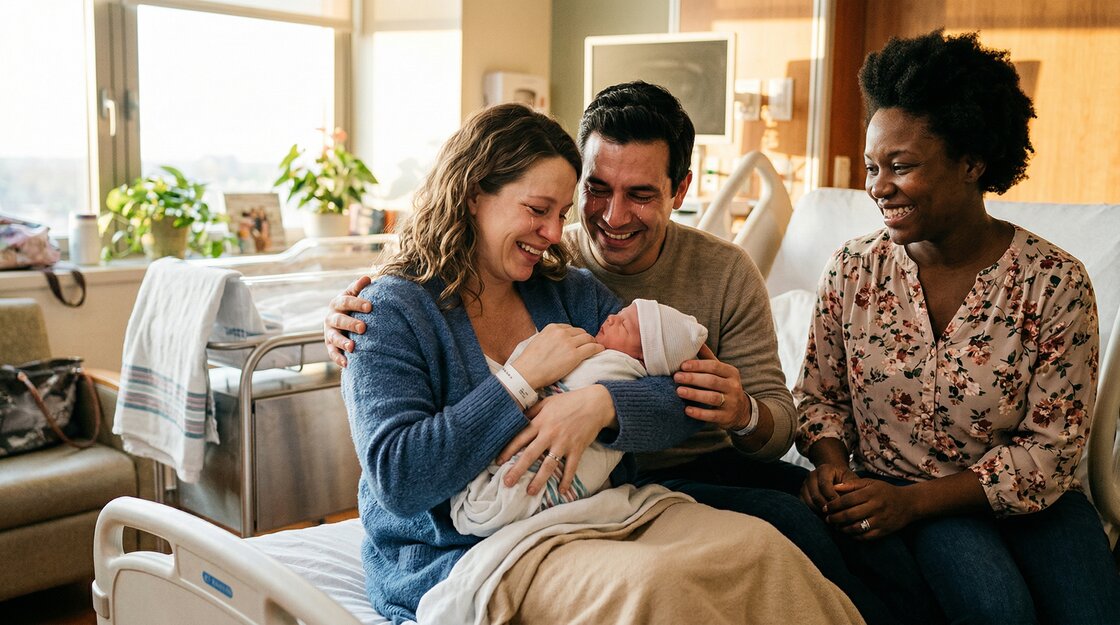
I don't usually get emotional reading press releases. But this one stopped me. On February 24, 2026, a baby girl was born in Georgia — which, fine, happens all the time — except she's the first child ever born through The Surrogacy Foundation's $100,000 grant program. Four years of medical trauma, a year of fundraising, and one genuinely extraordinary gestational carrier later, and here she is.
Baby girl McGill exists because a nonprofit in Atlanta looked at the $150,000+ price tag on surrogacy and said "that shouldn't be the end of someone's story." Bold thing to say. This birth is the first proof they can back it up.
I want to look at this from two sides: what it means for gestational carriers, and what it means for the intended parents who need programs like this to have any shot at all.
The Surrogate Who Made It Happen
Charlotte Ramberg lives in Cumming, Georgia. She's an experienced gestational carrier. She's also a licensed professional counselor who specializes in maternal and reproductive mental health. That combination — someone who's carried for another family and has the clinical training to understand what it costs emotionally — almost never exists in the same person.
Charlotte didn't just agree to carry the McGills' daughter. She knew exactly what she was walking into. People in surrogacy love calling carriers "heroes." I get it, but the word starts to lose meaning after you've seen it on a hundred Instagram posts. When someone with Charlotte's background — a woman who professionally counsels other women through the worst moments of their reproductive lives — volunteers to do this herself? That's different. That means something specific.
Shannon and Patrick McGill met Charlotte at The Surrogacy Foundation's annual Surrogacy Soirée in early 2025 — which, by the way, is the same fundraiser that generated the grant money in the first place. (I know.) Charlotte was already there. Then came the standard gauntlet: medical screenings, psych screenings, legal coordination, embryo transfer, and months of waiting.
"For me, surrogacy is an act of trust, hope, and responsibility. Every journey is unique, but the goal is the same. It is about helping a family welcome their child into the world. Watching Shannon participate in her daughter's delivery, then seeing her and Patrick hold her for the first time, was unforgettable. Outside of delivering my own children, it is one of the greatest honors of my life."
Charlotte's husband Kevin was with her the whole way. That sounds like a throwaway detail — it's not. A carrier's support system is the quiet backbone of every single journey, the part no one writes headlines about but everyone depends on. (It's also something agencies actively screen for during matching. For good reason.)
🤰 What Prospective Surrogates Should Know
- ✅ Grant programs like The Surrogacy Foundation's are real and growing — more families than ever have financial help to pursue surrogacy
- 🏥 Some agencies (Family Makers Surrogacy partnered on this one) actively work with grant-funded families — California agencies are especially active in grant partnerships
- 💬 You won't always know how a family's funding their journey during matching — but asking is completely fair game
- 💰 Your comp doesn't change based on how the family pays — escrow handles it, completely separate from how the IPs fund the journey. See your estimated compensation →
The Family Who Almost Couldn't Get Here
Shannon McGill was 33. She was delivering her son in May 2022 when everything went wrong — fast. Emergency C-section, then a severe hemorrhage, then the kind of decision nobody should have to make: an emergency hysterectomy to save her life.
Shannon survived. But she'd never carry another pregnancy.
She and her husband Patrick live in Canton, Georgia. They eventually found out that while Shannon couldn't carry, her eggs were still viable. Surrogacy was medically on the table. Financially? Not even close. Gestational surrogacy in the US routinely blows past $150,000 — agency fees, legal, medical, carrier compensation, insurance, escrow. For most families, that number just... ends the conversation. (Which, fair enough. It's a staggering sum.)
The McGills applied to The Surrogacy Foundation — an Atlanta-based nonprofit — and in October 2024 were awarded its second-ever $100,000 grant. The money came from the Foundation's annual Surrogacy Soirée, a fundraiser built to close exactly this kind of gap.
"After everything we endured, we knew our story wasn't over. Being told I needed a hysterectomy was devastating, but hearing that surrogacy was still possible gave us hope. The truth is, we could only move forward because of The Surrogacy Foundation's grant. Without their support, it likely would have been years before we held our baby girl. Now that she's here, it's hard to imagine having to wait any longer."
A whole network of providers stepped in with pro bono or discounted work: Family Makers Surrogacy handled the agency side, Atlanta Center for Reproductive Medicine (Dr. Ashley Tiegs) covered fertility, Thallo Health took on mental health support. Others chipped in too. The grant was the anchor. But it took an entire ecosystem of people willing to bend on their usual pricing to actually make the numbers work.
What $150,000 Does to a Dream
The cost barrier in surrogacy isn't news to anyone reading this. But I think it's worth saying plainly: most families who pursue surrogacy either already have real savings, go into significant debt, or just... don't. Median US household income is around $75,000. A surrogacy journey costs two to three times that. The math is brutal.
Grant programs like The Surrogacy Foundation's sit right in that gap — but they're rare, wildly competitive, and tiny relative to how many people need them. The Foundation's raised over $1 million total and will surpass $500,000 in lifetime direct financial support by the end of Surrogacy Awareness Month this March. Two more national grant recipients get announced by then.
Those are real numbers for a nonprofit. They're also a reminder of how big the hole actually is.
"We talk a lot about access to family building in theory. This is what it looks like in practice. A family who once heard 'you can't' is now holding their daughter because a community decided to step in."
For the surrogacy world, this birth is a signal worth watching: grant-funded surrogacy at real scale is possible, and it's starting to happen. The Foundation's model — community fundraising, serious application review, partner networks offering reduced rates — is replicable. Whether it actually scales depends on how much money and attention the surrogacy community decides to throw behind it. But the proof of concept? She's a baby girl in Georgia. She's here.
If You're Thinking About Becoming a Surrogate
If you're considering surrogacy, here's what I'd take from this: programs like The Surrogacy Foundation exist to match you with families who literally could not do this without financial help.
That matters for two reasons. One, it expands the pool of families pursuing surrogacy — more matches, more journeys, more opportunities for carriers who want to do this work. (If you're shopping around, our agency directory covers over 100 active programs.) Two, these tend to be families who've been through something real. Shannon McGill's story involves a medical emergency and years of waiting. The emotional stakes on the IP side are high — and honestly, that tends to produce partnerships built on genuine gratitude rather than transaction.
Charlotte Ramberg — experienced carrier, licensed counselor — chose this particular family. That kind of alignment between what a carrier cares about and what a family has survived is what makes a journey feel meaningful, not just complete.
Being a gestational carrier is one of the most significant things you can do with your body and your time. I don't say that lightly. Knowing your journey was funded by a grant — that a community raised money specifically so this family could get here — adds a layer most surrogates find deeply meaningful. Not complicated.
Considering surrogacy? Find out what your comp could actually look like in about 60 seconds.
Calculate my compensation →Thinking about becoming a surrogate?
See your estimated compensation based on your experience, state, and profile — no commitment required.
Calculate my compensation →Source: PR Newswire / The Surrogacy Foundation, March 4, 2026. All quotes attributed as originally published. SurroScore has no affiliation with The Surrogacy Foundation or any named agency or partner.